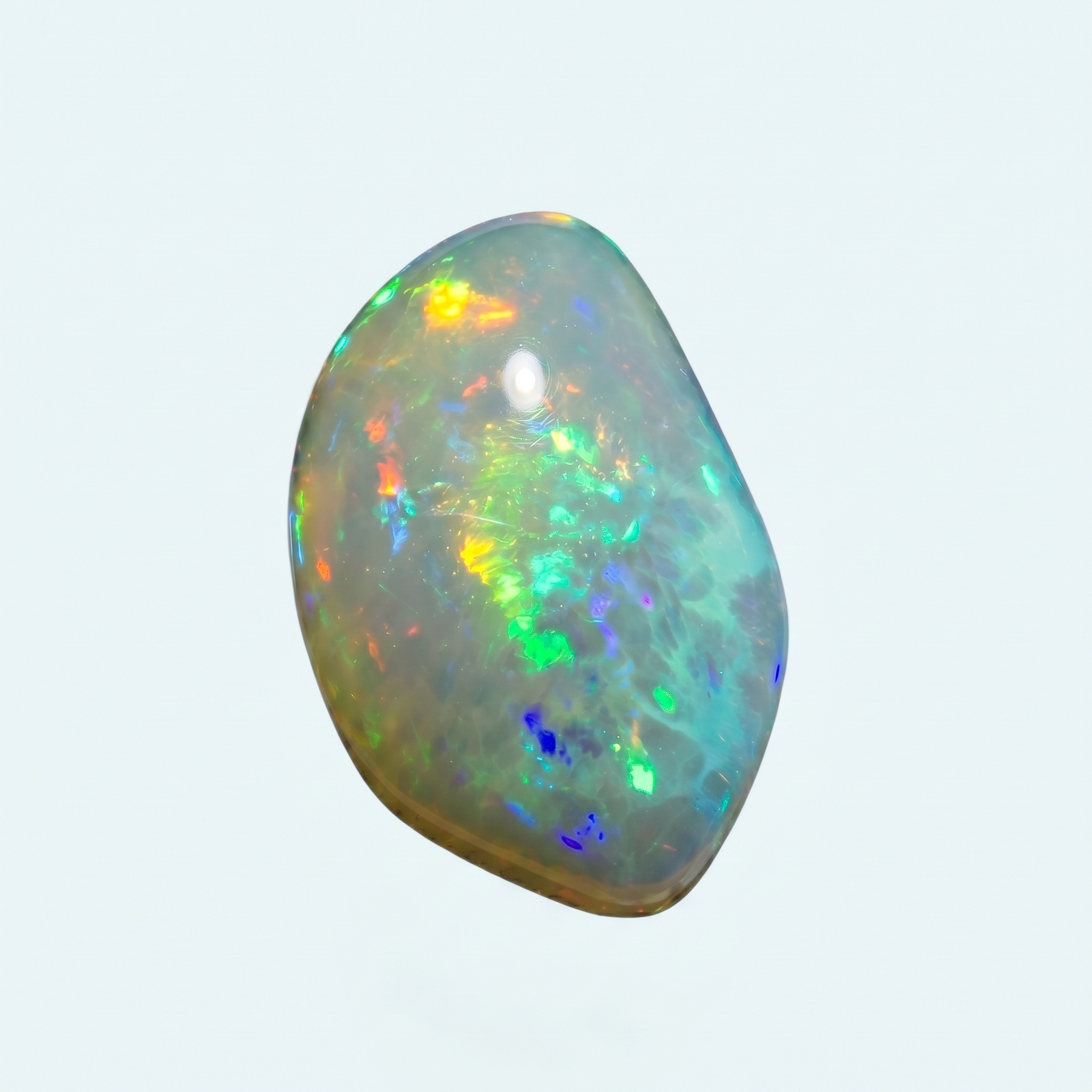
Opal
buying guide
A working guide to fine opal: play of color, body tone, the three origins, the hydrophane question, and what opal actually costs.

Opal is silica with water held inside, and it never formed a crystal. That is the chemistry. The light show is what the chemistry does.
Everything else about opal (the families, the origins, the care it asks for, the prices it commands) follows from how that light show is made. Millions of tiny silica spheres stacked in a regular grid split white light into spectral color, and no two opals break the light the same way. This guide walks through how to read an opal, what moves the price, and where honesty matters in this corner of the trade.
If you remember one thing from this piece: never clean an opal in an ultrasonic, and never let one bake dry. The water inside is part of the gemstone.
How to read play of colorbrightness, range, pattern, coverage
Play of color is the whole game. The flashes moving across a fine opal are not reflections and not dye. They come from inside the gemstone, from ordered silica spheres acting as a natural diffraction grating, and the trade judges them on four things.
Brightness comes first. A bright opal reads across a room, a dull one has to be coaxed under a lamp, and brightness moves price more than any other single factor. Color range is second. Blue and green flash is lovely and common. A stone that brings red and orange out of the same face is rarer and dearer, because red sits at the demanding end of the spectrum.
Pattern is how the color organizes itself. Broad flash sweeps in sheets, pinfire scatters in fine points, and harlequin, the rarest, lays color out in a mosaic of distinct blocks. The more deliberate the pattern, the more the stone is worth.
Coverage and direction finish the picture. Color that fills the face and holds as you tilt the stone beats color that hides at one angle or leaves dead spots. Ask to see any opal moving before you buy it. Stills flatter some stones and slander others.
Body tone sets the ceilingwhy black opal costs what it does
Underneath the fire sits the body, and its darkness has a name: body tone. A dark body makes play of color glow the way a campfire reads brighter at night. The same flash of red is simply louder against black, which is why black opal sits at the top of the market and white opal sits more gently.
Black opal from Lightning Ridge in Australia is the benchmark, with the strongest contrast and the highest prices. White and light opal, the heartland material of Coober Pedy, gives a softer read at far more reachable prices. Crystal opal is transparent to translucent, with the color suspended inside like weather in glass.
Boulder opal keeps a thin seam of color attached to its host ironstone, which lends a natural dark backing and real durability. Mexican fire opal is its own conversation, prized for a warm orange to red body with or without play of color.
Where opal comes fromAustralia, Ethiopia, Mexico
Australia set the standard for a century and still holds the ceiling, from the black opal of Lightning Ridge to the white opal of Coober Pedy and the boulder fields of Queensland. Australian opal formed under steady conditions, holds its water well, and ages gracefully.
Ethiopia changed the market. The Welo highlands, mined in earnest since 2008, produce bright, color saturated opal at prices that put real play of color within reach. Welo opal is hydrophane, which matters enough that it gets its own section below.
Mexico brings the fire opals, transparent warm oranges and reds cut from volcanic rock, some with play of color and many valued for the body color alone. Between the three origins there is an opal for nearly every taste and budget, which is exactly why the price ladder below runs so wide.
A dark body makes play of color glow the way a campfire reads brighter at night.
Why body tone moves price more than carat weight
Hydrophane, crazing, and carehow to live with opal
Much Ethiopian opal is hydrophane, meaning it drinks water. Submerge one and it can turn cloudy or shift transparency for hours until it dries out again. This is natural behavior and not a defect, but it changes how you live with the gemstone: no soaking, no liquid cleaners, no surprises.
All opal asks for care. It sits at 5.5 to 6.5 on the Mohs scale, softer than quartz, so store it apart from harder gems. Skip ultrasonic and steam cleaners entirely. Warm water, mild soap, a soft cloth. Avoid sudden heat and long dryness, because severe dehydration is what causes crazing, the fine network of surface cracks. How durability translates into value across every species is covered in our grading guide.
None of this should scare you off. Opal has been worn beautifully for generations. It simply wants to be treated like the living, light filled thing it is, and it rewards that care with a glow nothing else in the case can match.
Treatment, disclosure, and the false blacksmoke, sugar, and assembled stones
Most Australian opal is sold exactly as it came out of the ground. It needs nothing, and that honesty is part of what you are paying for.
Because a dark body is worth more, some Ethiopian opal is smoke treated or sugar and acid treated to darken it into a false black opal, and some is dyed outright. These are legitimate products only when they are disclosed and priced as treated. Undisclosed, they are the opal trade’s version of the lead glass ruby.
Assembled stones deserve the same plain language. A doublet bonds a thin slice of opal to a dark backing, and a triplet adds a clear cap on top. They make real opal affordable, and they are always sold as exactly what they are. If a price looks too good for solid black opal, it is a doublet, a treatment, or a problem. A laboratory report settles it, and our certificate guide shows you how to read one.
Our position is simple. We tell you the origin, we tell you whether the body tone is natural or induced, and natural black opal is sold as exactly that and priced accordingly.
Drawn from our live collection, 288 loose opals at the time of writing. Most of the collection lives between $1,000 and $2,500, where opal gives the most character for the money.
The ladder, made reallive stones from every rung
Each rung of the ladder above is shoppable. Up to three live stones per tier, every one of a kind: click any card to open it right here, buy it outright, or start a custom design around it.
Want more to choose from? See every opal we hold, or browse the full shop.
Let us pull a tray of opalsand watch them move in natural light
Tell us the body tone and budget you have in mind. We will send video in daylight, because opal more than any other gemstone has to be seen moving before it is chosen.
Browse Opal Collection

Leave a Reply