Tourmaline
buying guide
A working guide to fine tourmaline: the colors and their names, the Paraiba exception, how to read quality across a huge field, and what tourmaline actually costs.

Tourmaline is not one gemstone. It is a mineral family that grows in every color of the spectrum, sometimes two or three at once in a single crystal, and the trade has a different name for nearly each one.
That range is the whole appeal, and the whole challenge. A pink tourmaline and a blue green one share a name but little else, and they are priced worlds apart. This guide maps the colors worth knowing, the rare blue that earns its own market, how heat and clarity work here, and where the value lives across the widest field in colored gems.
If you remember one thing: in tourmaline, the name on the label is mostly marketing. Buy the color in front of you, and know which color carries the premium.
The colors and their namesrubellite, indicolite, chrome, and the two color crystals
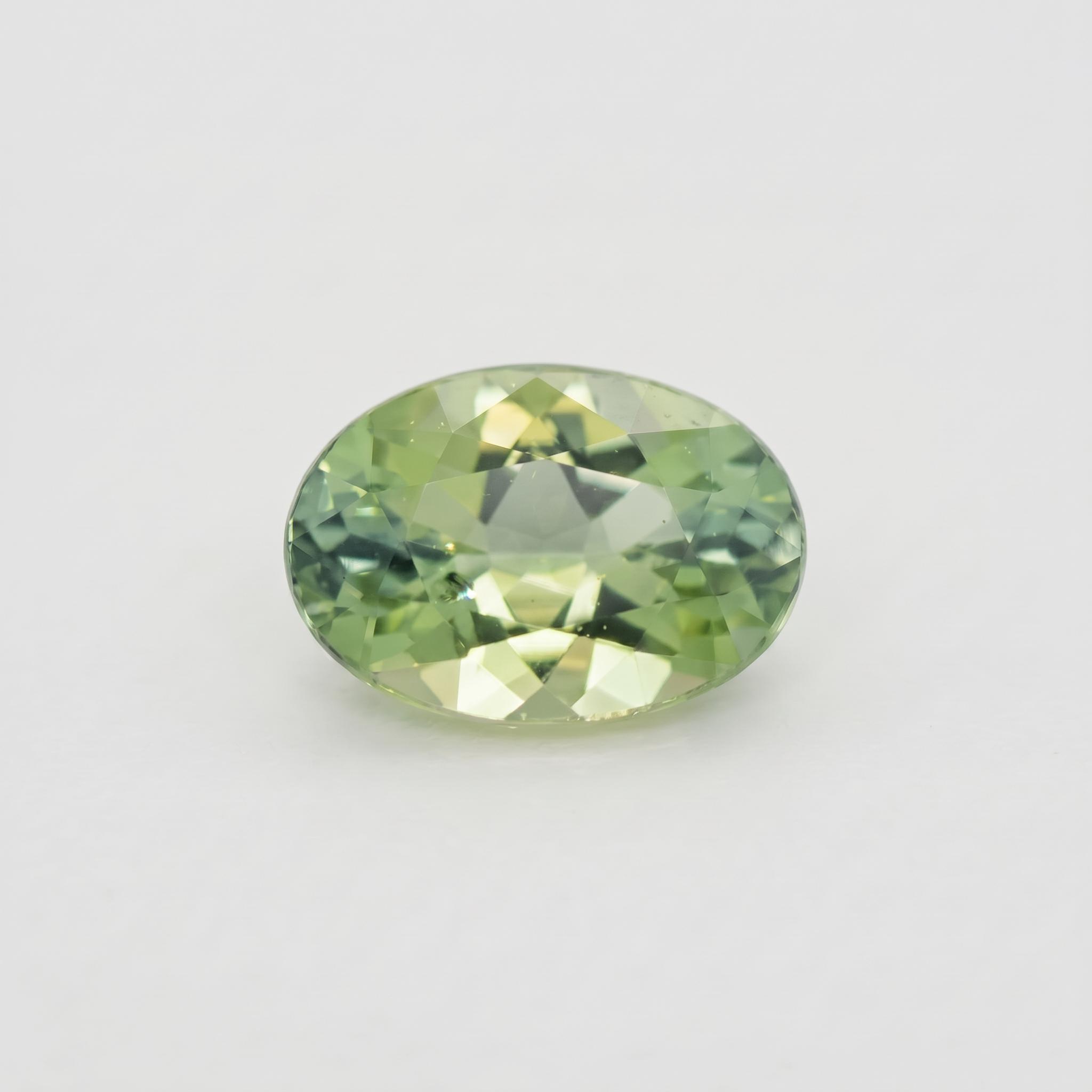
Tourmaline runs the entire spectrum, and the trade names the colors as it goes. Rubellite is the rich pink to red. Indicolite is the blue to blue green. Chrome tourmaline is a vivid forest green colored by the same element that fires emerald. Verdelite covers the broader greens, and there are yellows, oranges, and a near colorless besides.
Then there are the crystals that cannot pick one color. Bi-color tourmaline shifts from pink to green along its length, and the watermelon cut shows a pink center ringed by a green rind. These two color stones are a signature of the species and a favorite of collectors.
Pink and red lead the broad market on color alone, and a clean saturated rubellite carries a real premium. Green is the workhorse, beautiful and abundant. The single rarest color, the one that rewrote the price chart, gets its own section next.
Tourmaline is strongly pleochroic, showing different depths of color down different axes, so cutting orientation matters. A well cut stone faces up its best color rather than its darkest, which is why two stones of equal weight can look a grade apart.
Paraiba, the blue that broke the scalewhy one tourmaline costs like a ruby
In 1989 a new tourmaline came out of Paraiba, Brazil, in an electric neon blue and green unlike anything the species had shown. Colored by copper, it glows as if lit from within, and it broke the tourmaline price ceiling overnight.
Today copper bearing tourmaline from Brazil, and later from Mozambique and Nigeria, all trades as Paraiba on color, and the finest stones sell at prices that rival fine ruby and sapphire per carat. Size compounds it: clean Paraiba over a couple of carats is genuinely rare.
Paraiba is the one place in tourmaline where origin and lab reports move the price, so it earns the paperwork. We hold it as its own line. Everywhere else in the species, your eye is the better guide.
Clarity, cutting, and a little heatwhat to expect and what to accept
Most tourmaline is eye clean, and clean is the expectation in the pinks, greens, and blues. The exceptions are the deep rubellites, which often carry inclusions as a trait of their growth, and there the trade forgives a little more in exchange for color.
Gentle heat is common and accepted, used to lighten overly dark stones and improve blue and green tones. It is stable and permanent. Some pinks and reds are also irradiated to deepen color, a treatment that is stable but belongs on the disclosure, and we disclose it.
Tourmaline cuts cleanly and takes a bright polish, and it is hard enough for daily wear at 7 to 7.5 on the Mohs scale. Long crystals make it a favorite for emerald cuts and baguettes, where the color runs deep down the length of the stone.
A pink tourmaline and a blue green one share a name and little else.
Why color, not the label, sets the price in tourmaline
Where tourmaline comes fromBrazil, Africa, and Afghanistan
Brazil is the historic heart, from the Paraiba mines to the rubellite and bi-color crystals of Minas Gerais. It set the standard for the species and still produces across the range.
Africa carries much of the modern supply. Mozambique and Nigeria produce strong pinks, reds, and copper bearing blues, and Namibia and the wider continent add to the greens and the rest of the spectrum.
Afghanistan and Pakistan round out the field with fine pinks and greens. Across all of these, tourmaline is abundant enough that you are buying the individual stone, not the postcode, with Paraiba the lone exception.
Reading value across the fieldhow to spend well in the widest gem family
Here is how to spend well in the widest gem family. Start with color, because color is the price. Decide whether you want a pink, a green, a blue, or a two color crystal, then judge saturation and how evenly the color fills the face.
Let clarity be assumed outside the deep reds, and reward good cutting that faces up the best color. Size is friendlier here than in almost any fine gem, so a large clean stone need not be a fortune unless it is Paraiba.
The result is the best value in colored gems for sheer presence. A bright two carat tourmaline in the color you love costs a fraction of the equivalent sapphire, and looks like nothing else.
For another stone that wears many colors, see sapphire, or read our grading guide for how color and cut translate into value across every gemstone we carry.
Drawn from our live collection, more than 650 loose tourmalines at the time of writing, the deepest category we hold. About two thirds sit under $600, with a long tail up to a 71 carat flagship. Paraiba is priced on its own page.
The ladder, made reallive stones from every rung
Each rung of the ladder above is shoppable. Up to three live tourmalines per tier, every one of a kind: click any card to open it right here, buy it outright, or start a custom design around it.
Want more to choose from? See every tourmaline we hold, or browse the full shop.
Let us send tourmaline by colorand find the one you mean
Tell us the color and size you have in mind, pink, green, blue, or a two color crystal, and a budget. We will pull a tray and send video in daylight, because tourmaline is all about the exact shade.
Browse Tourmaline Collection

Leave a Reply