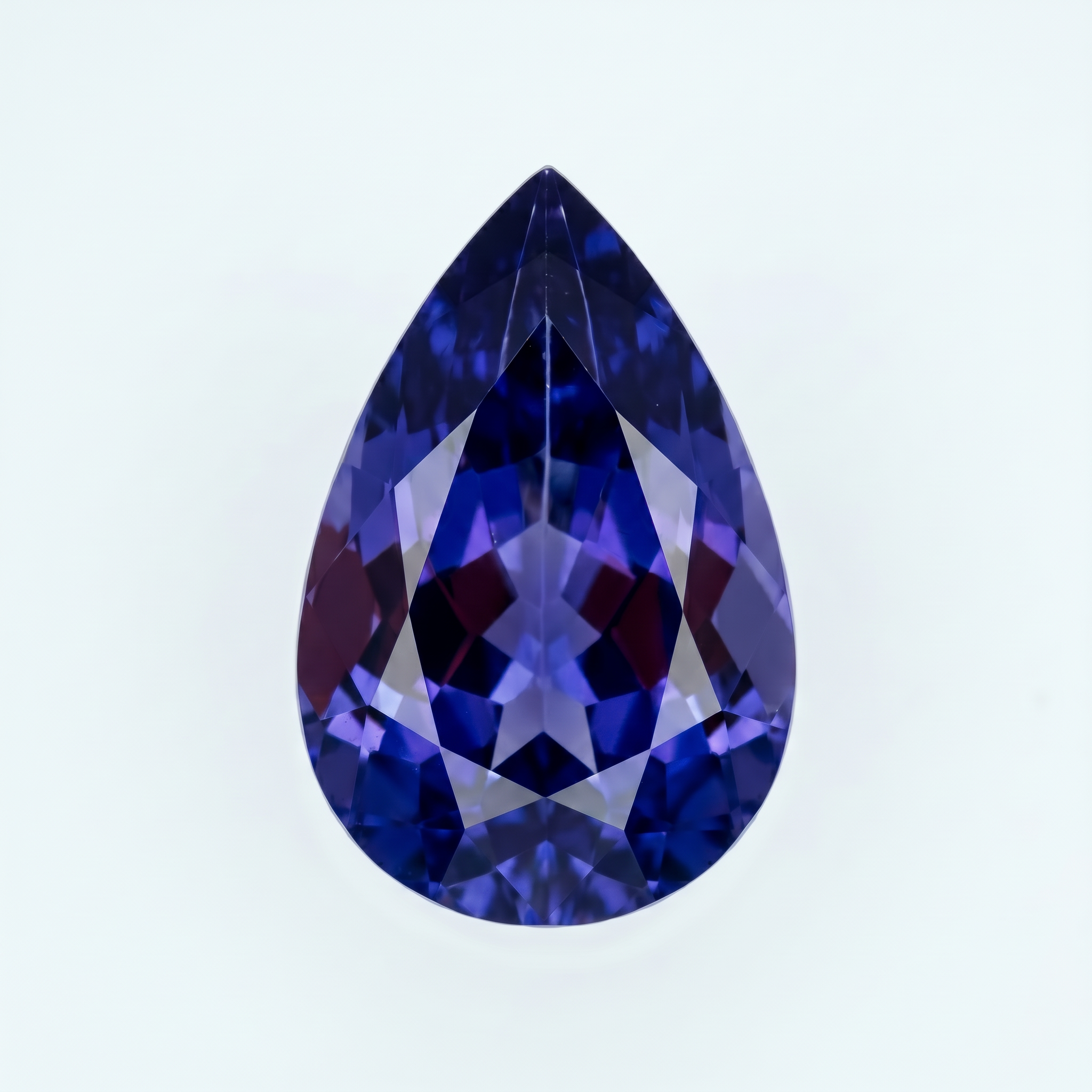
Tanzanite
buying guide
A working guide to fine tanzanite: the one place it comes from, the color that sets the price, the heat that makes it blue, and what tanzanite actually costs.

Tanzanite is found in exactly one place on earth, a few square miles of Tanzania, and the world did not know it existed until 1967. Every stone is, in a real sense, finite.
That scarcity is the whole story of the gemstone. Tanzanite shows blue, violet, and burgundy from a single crystal, takes a deep velvety color richer than almost anything at its price, and comes from a source geologists expect to run out. This guide covers the color that drives value, the heat that makes the blue, how to wear a softer stone well, and what it costs.
If you remember one thing from this piece: you are buying depth of blue from a single, finite mine. Treat the gemstone gently and it will outlast the supply.
Found in one placea few square miles of Tanzania
Tanzanite breaks the first rule of gemstones: it comes from a single source. The entire world supply is mined from the Merelani Hills in northern Tanzania, a stretch of ground a few miles across, and nowhere else has ever produced it.
It was unknown until 1967 and named by Tiffany and Co a year later, for the country that holds it. In gem terms that makes it brand new, and the rush to mine it has already worked through the easy material.
Geologists put the odds of a second deposit forming at close to none. Whatever scarcity means in this trade, tanzanite is the clearest case of it: a beautiful gemstone with a known, finite end to its supply.
Color is the price. Tanzanite is trichroic, which means a single crystal shows three colors at once, blue, violet, and a deep burgundy, depending on the angle you view it from. The cutter chooses which to face up, and the bluest faces command the most.
How to read the colorblue over violet, depth over all
The market ranks pure saturated blue first, a blue that rivals fine sapphire, then violetish blue, then the softer lavenders. Depth of color matters more than any other factor, and richer is dearer.
Size and color move together here. Small tanzanite tends to read more violet and pastel, while it takes a larger stone to hold a deep blue, so the big saturated blues are rare twice over.
Clarity is expected in fine tanzanite. The gemstone grows clean, and an eye clean stone is the baseline rather than the prize. Spend your attention on the blue.
Heat, and what it makeswhy nearly every tanzanite is heated
Nearly every tanzanite you will ever see is heated. Most rough comes out of the ground a muddy brown, and gentle heat transforms it permanently into the blue violet the gem is famous for. This is the accepted norm, not a flaw, and it holds for good.
Unheated tanzanite that is naturally blue is genuinely rare and prized by collectors, and we flag it when we have it. For nearly everyone, the heated blue is the honest, beautiful default.
Because the treatment is universal and stable, it is not a thing to fear or pay a premium to avoid. The real question in tanzanite is always the same one: how deep, and how blue.
A blue that rivals fine sapphire, from a mine the size of a neighborhood.
Why a single source makes tanzanite the value blue
Living with a softer stonesettings, care, and the cleavage truth
Tanzanite asks for more care than a sapphire, and rewards it. At 6 to 7 on the Mohs scale, with a cleavage plane that can split under a sharp knock, it is happiest in earrings, pendants, and rings worn for occasions rather than every day.
Set well, it lasts generations. A protective setting, a bezel or a guarded prong, lets a tanzanite ring be worn often. The thing to avoid is the hard accidental knock and the sudden temperature change.
Skip ultrasonic and steam cleaners entirely, because both heat and vibration are risks here. Warm water, mild soap, and a soft brush are all it ever needs.
A finite supplyone mine, and what it means for value
For a harder everyday blue violet at a friendlier price, see iolite, or compare it against the durable benchmark in our sapphire buying guide.
The single source shapes the value case. Tanzanite is priced well below sapphire for a comparable depth of blue, which makes it one of the best color values in fine gems today.
But the supply is the asset. As the Merelani material gets harder to reach, fine deep blue tanzanite has only one direction to go. Buyers who want the color tend to buy it while the buying is good.
To see how color, clarity, and cut translate into value across every gemstone we carry, read our grading guide.
Drawn from our live collection, about 80 loose tanzanites at the time of writing. The collection centers between $1,000 and $2,500, with very little under $400 and a top end at a 10 carat blue.
The ladder, made reallive stones from every rung
Each rung of the ladder above is shoppable. Up to three live tanzanites per tier, every one of a kind: click any card to open it right here, buy it outright, or start a custom design around it.
Want more to choose from? See every tanzanite we hold, or browse the full shop.
Let us send tanzanite in daylightand find your depth of blue
Tell us the depth of blue and the size you have in mind. We will pull a tray and send video in natural light, because tanzanite shifts between blue and violet as the light moves.
Browse Tanzanite Collection

Leave a Reply